Reading
 Paco arrived in London two hours ago
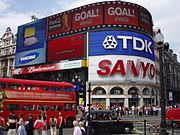
Paco arrived in London two hours ago. He travelled from Madrid Barajas to London Heathrow. He waited for his luggage at the airport and then he took the tube to the town centre, where he had previously made a reservation. When he arrived at the hotel, Paco was a bit excited, so that he left his things there and went out for a walk along the streets of London.
| |
 |
 |
| By Arpingstone. Public domain |
By Javier Gil. GNU license
|
By Riffleman 82. Public domain |
Read the text and answer these questions
1. How did he go from the airport to the city centre?
2. Did he have to book a hotel when he arrived in London?
3. What did he do after he had left his things in the hotel?
4. What was his first impression about London?
5. He went to bed at midnight because he didn't find anything interesting to see. Is that correct? If it isn't, make it right
Paco got up early the following day
Paco got up early the following day
Paco got up early the following day of his arrival. He felt excited
with a so big city. There were so many places to visit that he didn't
know where to begin. He wanted to see all the museums and famous
buildings in town, so he ordered some Indian food to take away by midday. He ate
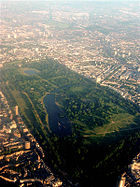
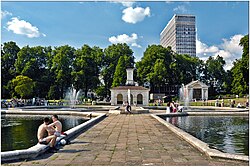
his meal in Hyde Park, one of the largest green spaces in Central London. He stayed there a couple of hours, he relaxed and then walked along the drives and ways of the park.
 |
 |
| By Ben Leto. Creative Commons | By Panos Asproulis. Creative Commons |
He had too many days to visit museums and other places. He preferred to spend some time in the park. Besides, there were lots of attractions. He went to the Speaker's Corner , where a lot of people listened to the speakers' speeches about Politics, social critics and other topics. Paco was astonished.
First impressions
Paco tasted the Indian food for lunch. It was delicious but he didn't take into account the hot grade of the food he ordered. It was really hot, so he didn't finish it. He was drinking water and soft drinks in the evening. There were some foreigners having lunch by his side in the park and they didn't take all the food because it was also too spicy. He looked up the magic word in a dictionary for the next time: mild.
 |
 |
 |
| By Kspoddar. Creative Commons |
By Kspoddar. Creative Commons | By warriorgrrl. Creative Commons |
Note these two adjectives: hot and mild.
When they are used to talk about food, they can have a different meaning.
 Curiosity
Audio
Take-out (in North American English), carry-out (in U.S. and Scottish English), take-away (in England, Australia, Hong Kong and Ireland) or parcel (in Indian English), is food purchased at a restaurant but eaten elsewhere. The restaurant may or may not provide table service. In the United States and Canada, food ordered this way (especially in fast food) is ordered to go, and in the United Kingdom it is ordered to take away or sometimes to eat out, as opposed to eating in.
In some cases, there are facilities for customers to order food by telephone, fax, or over the Internet, to be collected or delivered. This trend is thought to be on the rise as many small businesses take to the Web to promote their take-outs.
Food that is delivered by a restaurant to a customer (often called delivery) is also sometimes called take-out. Establishments that sell take-out exclusively without providing table service are called take-out restaurants or take-aways.
 |
 |
 |
| By Rainer Z. GNU license |
By Solipsist. Creative Commons |
By Kbh3rd. Public domain |
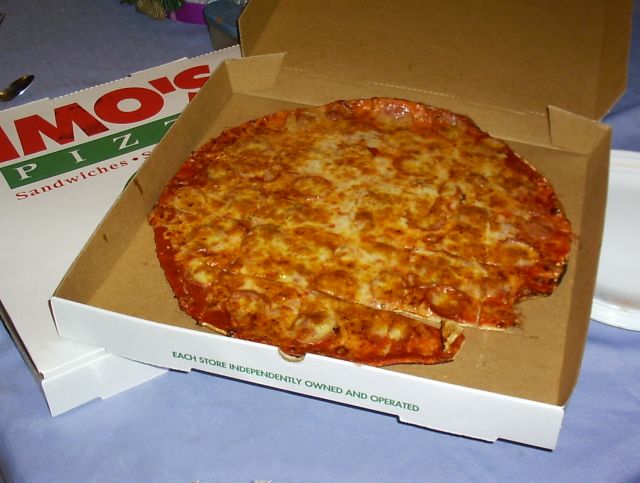
Certain types of food that are normally served in sit-down restaurants are commonly available as take-out. Pizza is one example: some pizzerias and chains have no tables, and supply for take-out and delivery only. Another classic take-out food is Western-styled Chinese food. In the past few decades, as immigrants from more and more Asian countries emigrate to the West, more and more types of cuisine are available: Japanese, Thai, Korean, Vietnamese, etc. In the UK, Indian food is also a popular form of take-away as well as kebabs from the Middle East.
Some businesses have taken a cue from the ever increasing popularity in takeout, and have created franchises to deliver food from restaurants which do not themselves deliver.
Adapted from Wikipedia.